
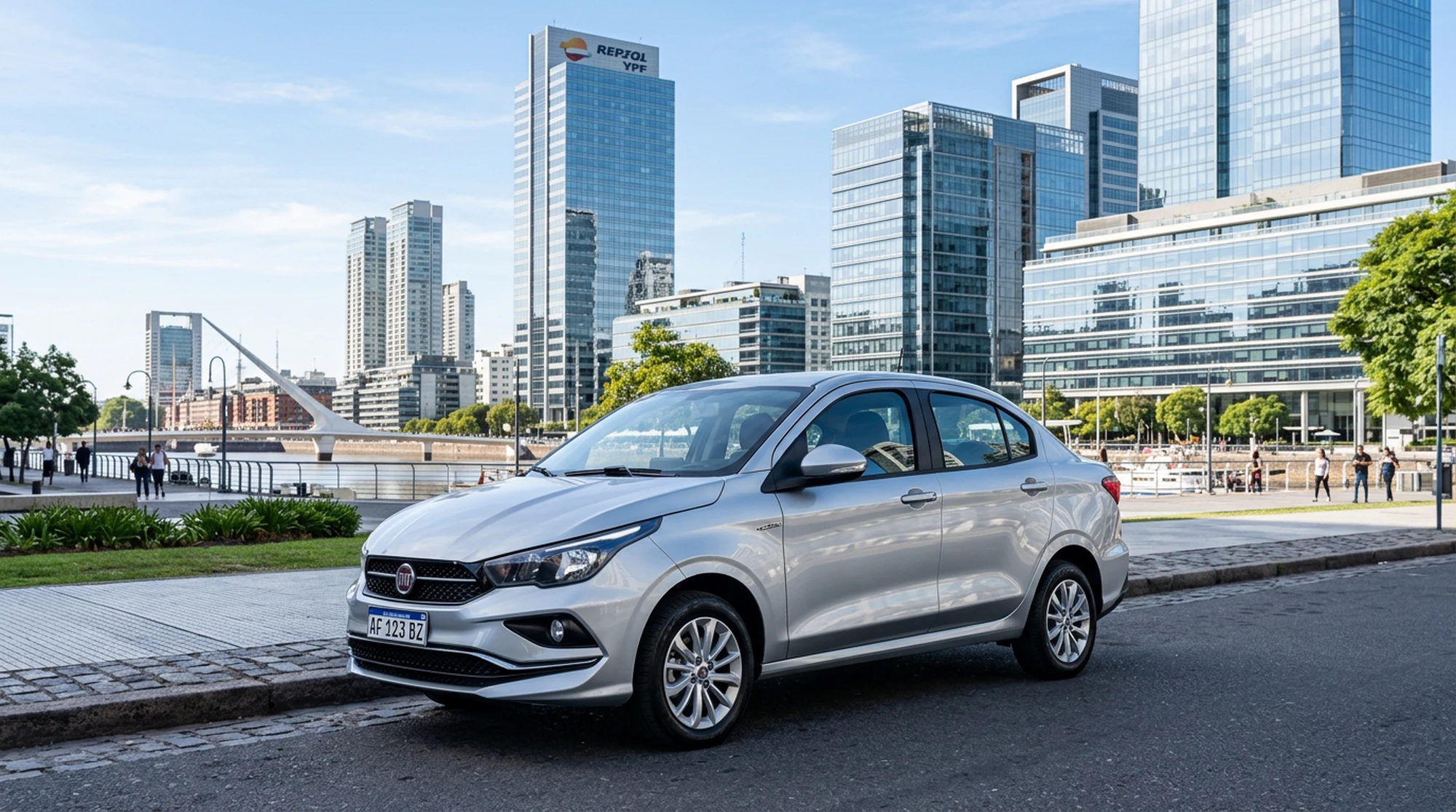
Driving in Buenos Aires takes a certain amount of patience that no car can remove. Dense traffic, traffic lights every other block and avenues that seize up at certain hours. An automatic gearbox does not change that context, but it reduces the physical work: no clutch, no biting point to find, and the left foot rests.
That shows up more on short, repeated trips than on a long highway drive. An automatic car for the city makes sense for someone who goes out several times a day, for a visitor who does not want to adapt to another way of driving, or for a company that needs any team member to use the vehicle without prior practice. Availability of automatic units is confirmed when you book.
What changes in traffic
In a jam, the difference is in the left foot. With an automatic, the driver only accelerates and brakes. Slow progress is controlled with the brake and the car stays still without holding the clutch. Over an hour crossing the city centre, that means less fatigue when you arrive.
On slopes, such as car park ramps, the automatic also simplifies pulling away. Even so, use the handbrake on a hill and do not rely on momentum alone. Caution still belongs to the driver, not the gearbox.
The downside is habit: someone who has driven a manual for years will reach for the clutch pedal. A couple of kilometres are enough to correct it, but do it on a quiet street rather than at the first junction.
Parking and manoeuvres
Parking in the city centre is a chapter of its own. Narrow ramps, columns and tight spaces. The automatic helps because it lets you move the car precisely at low speed without fighting the biting point.
For parallel parking, the procedure is the same as with a manual: indicate, line up with the reference car, turn and correct. The difference is that clutch and accelerator no longer need to be coordinated. You do have to remember to select P and apply the handbrake before getting out.
If the car has a camera or sensors, use them as support, not as a replacement for looking. Mirrors remain the main tool, especially with motorbikes, pedestrians or a delivery truck on the same block.
Category and availability
American Rent a Car works with three categories: Small, Medium and Large. An automatic gearbox is not guaranteed on every unit or every date. The booking is confirmed by category and gearbox, not by a specific model.
If the trip includes four passengers with suitcases, a Small car may be too tight even if it is automatic. If the route is urban and you park often, a Medium is usually a good balance. The decision is based on passengers, luggage and type of route, not only on the transmission.
Habits that help
A few habits make the experience simpler. Keep the left foot on the rest, use D to move forward and R only to reverse, and select P before switching off the engine. On a ramp, the handbrake stops the car from rolling when you release the brake.
In slow traffic there is no need to accelerate and brake constantly: the car creeps forward when you release the brake. That detail is less tiring on a long drive. It also helps to check the dashboard before leaving, to confirm no warning light stayed on.
Booking and pickup in the city
The Microcentro branch, at 25 de Mayo 277, is the natural option for anyone working or staying downtown. The pickup time is arranged over WhatsApp when you book. The requirements are the same as for any rental: age 21, valid licence, national ID card or passport, and a credit card for the deposit.
The minimum rental period is 72 hours. The car must be returned with the same fuel level and clean, with a one hour tolerance. You can book online or talk to the team. The Microcentro rental branch handles pickups downtown.